The Power of 3: Why Most Hiring Processes Get Two Right and Miss the Third
46% of new hires fail within 18 months, and only 11% of those failures trace back to someone’s skills. This reality for hiring success has stuck with me for years, because it lines up almost exactly with what I saw running talent acquisition and retention inside high-growth companies.
So here’s a question worth asking before your next interview. Who on your panel actually owns understanding the candidate’s WHY? Their motivation and drivers at this moment in the career and life?
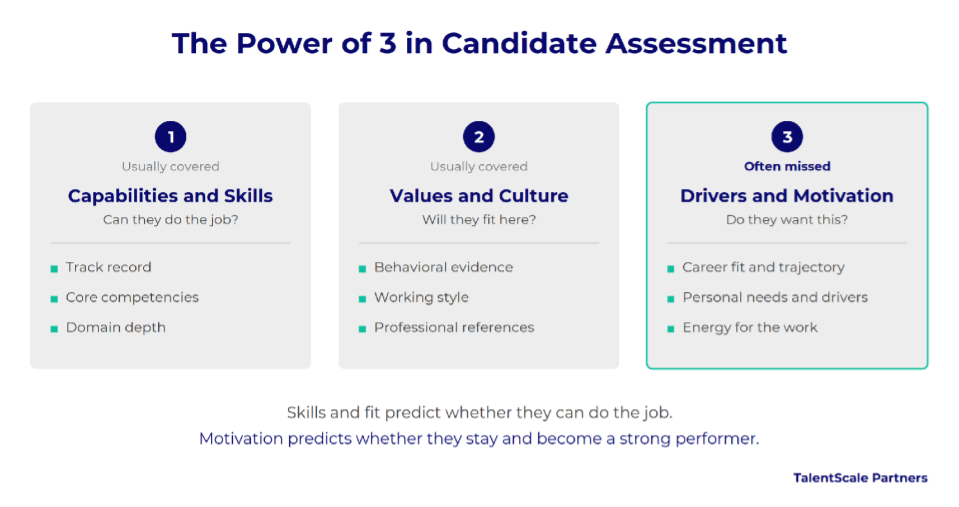
In my experience, most companies build a hiring process around three assessment areas. They tend to do a reasonable job on the first two and often miss the third.
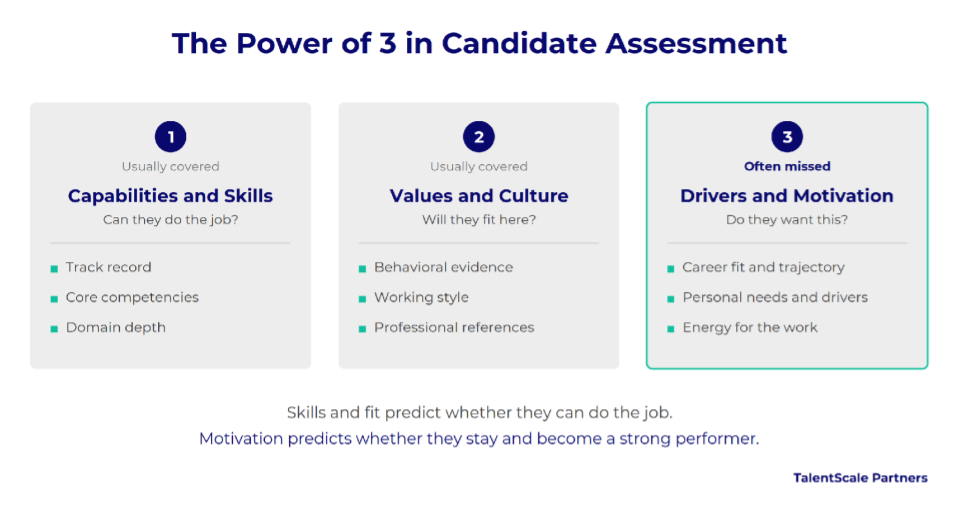
1️⃣ Capabilities, skills and track record
This is the part everyone gets right. The job profile is written, the responsibilities are clear, and the interview loop is built to test whether the candidate has done this before and done it well.
Companies invest serious effort here. They bring in technical experts when internal depth is thin. They dig into scope, scale, and results. When a new hire goes sideways, it is normally not because the hiring team failed to check whether someone could do the work.
2️⃣ Core values and culture fit
This is the second area most teams cover well, and it has gotten meaningfully better over the last decade. Behavioral interviews tied to actual company values. Values assigned across interviewers so everyone is not asking the same generic questions. A clear read on whether this person’s style will work with the hiring manager and the team.
It takes discipline, but the best practice is well understood. Most experienced hiring teams know how to do it.
3️⃣ Motivation and career fit
This is where the hiring process usually breaks down.
Motivation is not “is this person excited about the opportunity?” Everyone is excited at offer stage. Motivation is whether the majority of the day to day responsibilities actually energize this person, whether the role fits where they are in their career arc, and whether the company can support what they need on the personal side.
That last part matters more than it used to. Post-Covid, with flexible working models now the norm rather than the exception, I have watched top talent place substantial weight on how a role fits their life. Family. Volunteer commitments. Time for health and wellbeing. Ten years ago those factors came up late, if at all. Now it is a critical factor for success and retention, and companies that never surface them find out after the offer is signed.
What the data looked like from the inside
At a large software company, I owned understanding the drivers behind retention and attrition. We pulled apart exit interview data looking for patterns.
Over one third of all exits came back to a lack of motivation for the role and responsibilities itself.
Over half of regrettable resignations from team members leaving within their first year came back to the same thing, a lack of motivation for the work.
These were not skills problems. These were not culture problems. These were people who could do the job and who fit the team, but who were never truly motivated by the work or by what the role meant for their career.
How we work with clients to assess career drivers and motivation
Motivational fit is not a gut read. It is uncovered through deliberate, open ended questions asked early and revisited throughout the hiring process.
Start with open questions, not the job description
Two we leverage constantly:
“What are the ideal characteristics of a company you’d want to join?”
“What are the characteristics of an ideal role within that company?”
Ask these before the candidate has enough information to align their answers to what they think you’ll want. What comes back is usually an honest, frank response, and it gives you a basis to map their motives and drivers to the actual responsibilities of the role.
Map the answers to the actual job
Take the responsibilities that consume the most time and energy in this role, and ask directly whether those are the things that motivate this person. Not whether they are capable of them. It is whether they want to spend their days doing them.
Assign an owner
This is the step most processes miss. Capabilities have an owner. Values usually have owners. Motivation gets left to whoever happens to ask. Someone needs to be accountable for understanding a candidate’s WHY, and for carrying that understanding through every stage. The hiring manager can partly own this, but unconscious bias often is a factor on both sides that can make this difficult to get truly honest responses.
Use a neutral owner
An internal recruiter or an external search partner is often the right person for this. They can act as a career coach with a goal to make the best match for both the company and candidate. They’re able to talk to the candidate as a trusted advisor, outside the formal loop, across weeks, and they hear things that never surface in a panel interview. But it only works if they have the time and capability to focus on and effectively assess motivations, and the hiring manager takes the input into account in making the hiring decision.
Bottom line
Plenty of hiring managers get the skills assessment and fit right. Then they lose the person in six or twelve months over personal and professional drivers they never knew about or took the time to understand.
Truly leveraging best practices to hire for your role goes beyond the typical assessments for skill and fit. It means covering a third component, motivation and drivers, that is often missed but very critical to the ultimate success of your new hire.
At TalentScale Partners, uncovering candidate drivers and career fit is a core part of how we run every search.
We build in the deliberate questions, assign clear ownership, and act as the trusted, neutral advisor who can surface what panel interviews rarely do. If you want a process that gives your next hire a real shot at lasting success, we'd love to connect. Reach out at contact@talentscalepartners.com.
More Insights on Search Process